Crochet hook sizing is often one of the most frustrating obstacles for makers navigating international patterns. Between US letter designations that vary by brand, vintage UK numbered sizing that runs in reverse, and modern metric millimeter diameters, working with the wrong tool can drastically alter your project’s gauge and fit. In this definitive hook reference guide, we establish the scientific millimeter as the universal standard, dissect hook throat anatomy, and explain how to match mystery yarns to the ideal hook.
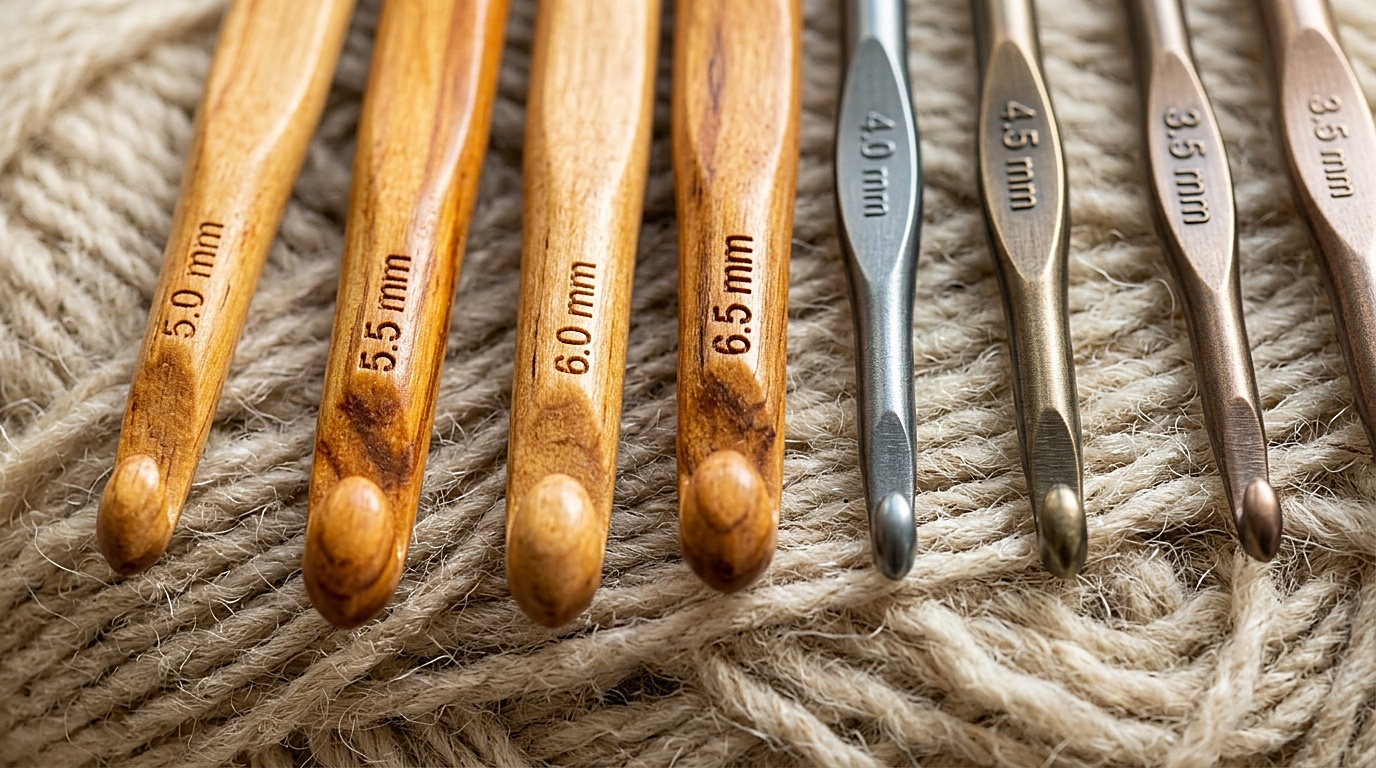
The fundamental principle of crochet physics is simple: the diameter of the hook’s shaft (the section directly below the throat) determines the exact interior circumference of the loop you draw up. Letters and numbers stamped on handles are marketing conventions that vary across manufacturers; only the millimeter diameter provides a true scientific measurement.
Comprehensive Master Hook Sizing & Conversion Matrix
Use this reference table to translate between US letters, metric diameters, and vintage UK/Canadian designations:
| Metric Diameter (mm) | US Letter / Number | UK / Canadian Size | Standard Yarn Weight Category |
|---|---|---|---|
| 2.25 mm | B-1 | 13 | #1 Super Fine (Fingering / Sock) |
| 2.75 mm | C-2 | 12 | #2 Fine (Sport / Baby) |
| 3.25 mm | D-3 | 10 | #2 Fine / Light #3 DK |
| 3.50 mm | E-4 | 9 | #3 Light (DK / Light Worsted) |
| 3.75 mm | F-5 | — | #3 Light (DK) |
| 4.00 mm | G-6 | 8 | #3 Light / #4 Worsted |
| 4.50 mm | 7 | 7 | #4 Medium (Worsted / Aran) |
| 5.00 mm | H-8 | 6 | #4 Medium (Worsted) |
| 5.50 mm | I-9 | 5 | #4 Medium (Aran) |
| 6.00 mm | J-10 | 4 | #4 Medium / #5 Bulky |
| 6.50 mm | K-10.5 | 3 | #5 Bulky (Chunky) |
| 8.00 mm | L-11 | 0 | #5 Bulky / #6 Super Bulky |
| 9.00 mm | M/N-13 | 00 | #6 Super Bulky |
| 10.00 mm | N/P-15 | 000 | #6 Super Bulky |
Hook Anatomy: Inline vs. Tapered Throats

Beyond diameter, the physical shape of a hook head dramatically impacts stitch execution:
- Inline Hooks (e.g., Susan Bates): The hook notch is cut directly into the shaft cylinder, meaning the head is the exact same width as the shaft. The thumb rest is typically closer to the head. Inline hooks offer excellent stitch size consistency, making them ideal for beginners learning uniform tension.
- Tapered Hooks (e.g., Boye, Clover Amour, Tulip Etimo): The neck tapers narrower beneath a rounded, smooth head. Tapered hooks slip into tight stitches effortlessly, reducing wrist strain for fast makers and preventing yarn splitting with multi-ply fibers.
Material Selection: Aluminum, Wood, and Ergonomic Grips

- Polished Aluminum: High speed and zero drag. Best for grippy fibers like 100% kitchen cotton or coarse rustic wool.
- Bamboo & Hardwoods: Gentle fiber grip with natural warm flex. Ideal for slick, slippery fibers like silk, bamboo rayon, and mercerized cotton.
- Ergonomic Elastomer Handles: Wider contoured grips distribute palm pressure, allowing makers with carpal tunnel, arthritis, or joint fatigue to crochet comfortably for extended sessions.
The Wraps Per Inch (WPI) Test for Mystery Yarns
If you have unbanded yarn in your stash, calculate the ideal hook size using the scientific Wraps Per Inch (WPI) test:
- Take a standard ruler and wrap the yarn around it smoothly, side-by-side, without overlapping or stretching the strand.
- Measure how many strands fit across exactly 1 inch (2.5 cm).
- Evaluate WPI:
- 6–7 WPI: Category #6 Super Bulky ➔ Use 9.0–10.0 mm hook.
- 8–9 WPI: Category #5 Bulky ➔ Use 6.5–8.0 mm hook.
- 11–12 WPI: Category #4 Worsted ➔ Use 5.0–5.5 mm hook.
- 13–15 WPI: Category #3 DK ➔ Use 3.75–4.5 mm hook.
- 16–18 WPI: Category #2 Sport ➔ Use 3.25–3.5 mm hook.
Artisan Tool Care & Longevity

A high-quality hook can last decades when maintained properly:
- Protecting Throats: Never toss metal hooks loose into bags with steel scissors; micro-scratches on aluminum heads will snag delicate lace threads.
- Conditioning Wood: Rub wooden hooks with a drop of jojoba oil or beeswax once a year to preserve moisture and prevent brittleness.
Save This Guide to Pinterest
Never guess hook sizes again! Save this comprehensive metric conversion chart to your Pinterest reference boards.