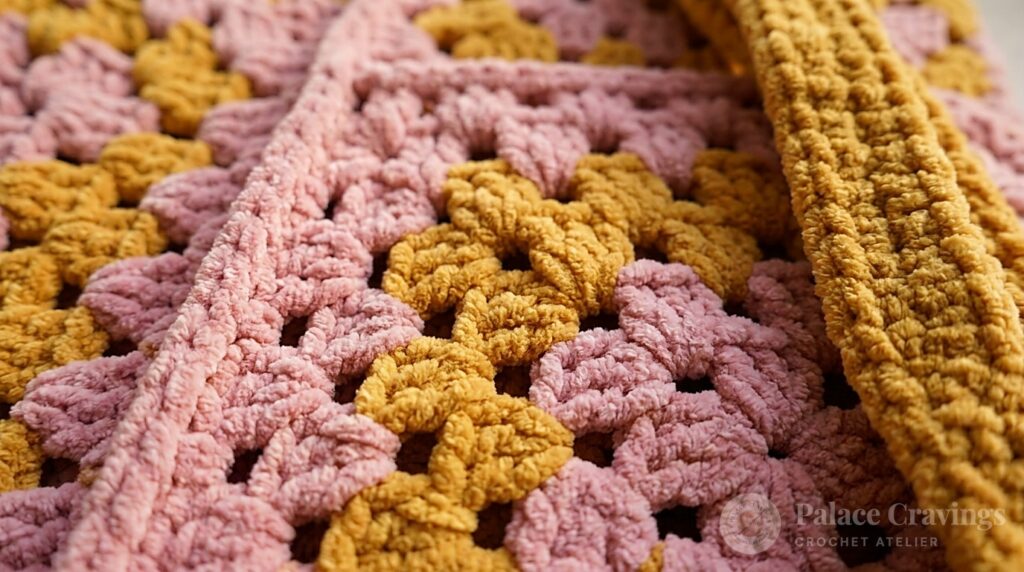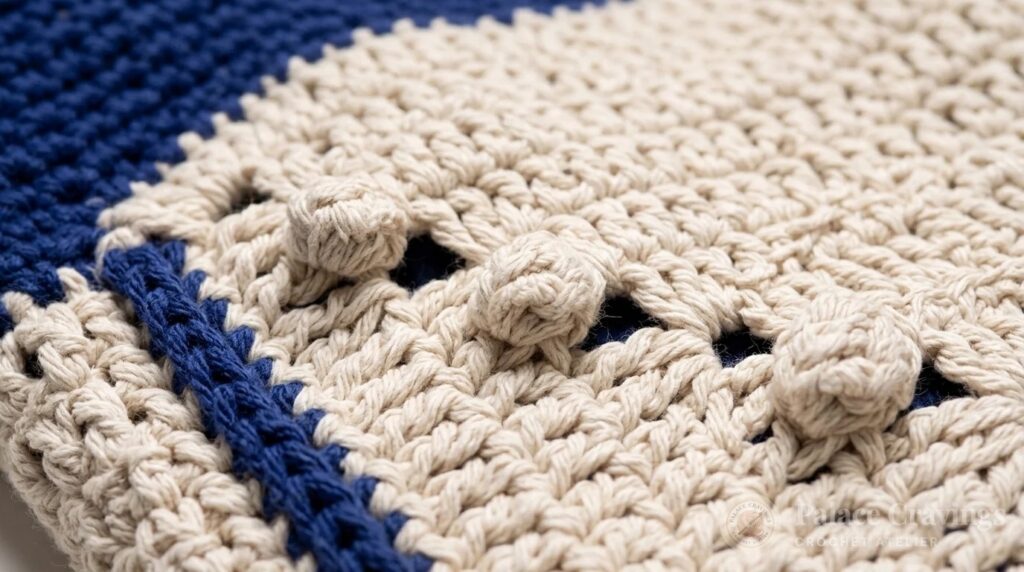
A functional market tote requires a deliberate balance between structural load-bearing and open elasticity. Unlike solid fabric bags that feel heavy and rigid, this French market crochet bag utilizes an engineered base oval paired with an expanding diamond mesh body. Worked from the bottom up in 100% natural unmercerized cotton, the netting expands dynamically to accommodate bulky farmers’ market produce, while reinforced thermal handles distribute weight across the shoulder without excessive drooping.
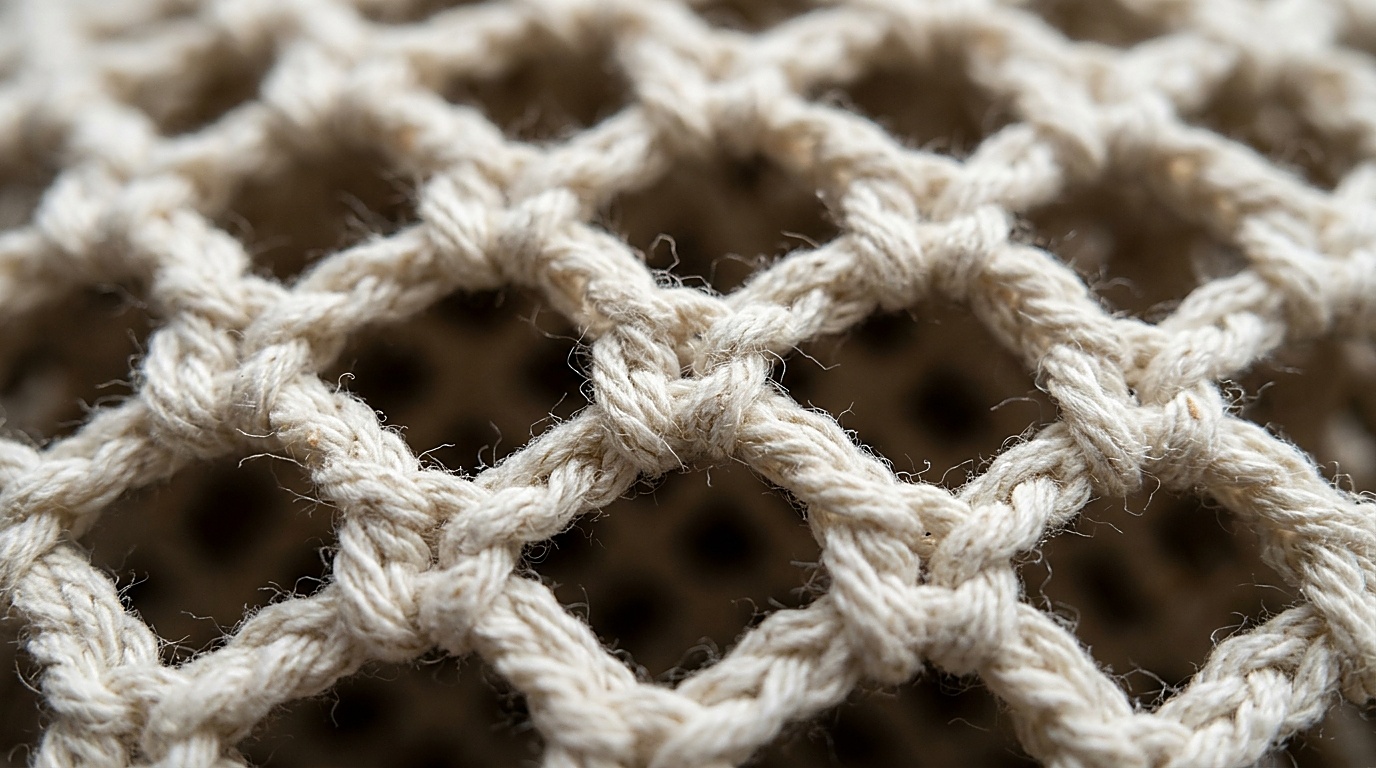
Crochet mesh bags frequently fail when maker tension or yarn choice is mismatched. When loaded with heavier items like apples or squash, standard chain loops can stretch uncontrollably. By establishing a dense, non-stretch oval base and integrating stabilized top-collar straps, this pattern creates a reliable reusable bag designed for practical everyday utility.
Load Distribution Mechanics: Solid Base vs. Open Mesh
The engineering of this tote divides into three functional zones:
- Zone 1 (Reinforced Floor): A solid oval worked in dense single crochet prevents smaller items from poking through and anchors the bag’s center of gravity.
- Zone 2 (Diamond Netting Body): Interlocking chain-5 loops form a diamond lattice. When resting empty, the bag contracts into a compact silhouette; when filled, the diamonds expand horizontally and vertically to cradle irregular shapes.
- Zone 3 (Load-Bearing Rim & Straps): The open mesh transitions back into concentrated decrease rounds of single crochet, securing the handle anchor points and preventing strap elongation under weight.
Reference Cotton & Tensile Specifications

Fiber choice is critical for utilitarian bags. Mercerized or synthetic yarns are overly slick and prone to stretching out of shape:
- REFERENCE_YARN: Category #4 Medium 100% Unmercerized Cotton (e.g., Lily Sugar’n Cream or KnitPicks Dishie; approx. 280–320 yds / 255–295 m total).
- REFERENCE_HOOK: 4.0 mm (US Size G/6) hook. Sizing down from the standard 5.0 mm recommended on the yarn band creates a tighter base weave with minimal stitch give.
- BASE_GAUGE: [Target Pattern Standard — GAUGE: NEEDS PHYSICAL VERIFICATION for maker tension]
16 sc × 18 rows = 10 × 10 cm (4 × 4 inches) in solid single crochet. - DIMENSIONS: [LOAD_CAPACITY & STRETCH: NEEDS PHYSICAL VERIFICATION]
Flat base measures approx. 9.5 in × 4 in (24 cm × 10 cm); mesh body expands up to approx. 16 in (40 cm) wide when filled.
Stage 1: Engineering the Non-Stretch Oval Base
The base is worked in the round around both sides of an initial foundation chain:
Foundation: Chain 25 loosely.
Round 1: Work 2 sc in the 2nd chain from the hook. Sc in each of the next 22 chains. Work 4 sc into the final chain to curve smoothly around the end. Now working along the opposite, unworked side of the chain: sc in the next 22 chain spaces, and work 2 sc into the same beginning chain space. Join with a slip stitch to the first sc. Place marker. (52 sc total)
Rounds 2 through 4: Ch 1 (does not count as a stitch). Work 2 sc in each of the 2 curved end stitches, sc across the 22 straight side stitches, work 2 sc in each of the 4 opposite curved stitches, sc 22, and work 2 sc in each of the final 2 end stitches. Join with sl st. By Round 4, the oval base reaches 76 active stitches, providing a flat foundation.
Stage 2: Transitioning to the Expanding Diamond Mesh

Round 5 (Mesh Setup): Ch 1. Sc in the first st, *chain 5, skip 2 stitches, sc in the next stitch*. Repeat from * to * around the oval perimeter. End with ch 2, and work 1 dc into the first sc of the round (this counts as the final ch-5 space and positions your hook at the apex of the loop). (25 mesh arches formed)
Rounds 6 through 24: *Ch 5, sc into the center of the next ch-5 arch*. Continue working in a continuous spiral, marking the beginning of each round with a stitch marker. Work 19 rounds of open netting, or until the empty mesh body measures approximately 11 inches (28 cm) from the base.
Stage 3: Upper Collar Decreases & High-Tension Straps
To transfer cargo stress away from the delicate netting loops, the collar must gather the arches securely:
Collar Round 1: Ch 1. Work 2 sc into each ch-5 space around the bag rim. Join with sl st to first sc. (50 sc total, cinching the top opening neatly).
Collar Round 2: Ch 1. Sc in each st around. Turn your attention to handle placement by marking 4 equidistant points: 14 stitches across the front center, 14 stitches across the back center, with 11 stitches along each side underarm.
Handle Construction: Sc to the first front marker. Chain 70 loosely (or chain to desired strap drop, typically 24 inches for a comfortable shoulder carry). Being careful not to twist the chain, skip the 14 front center stitches and join with an sc at the second marker. Sc across to the back marker, chain 70, skip 14 back stitches, and sc to the beginning of the round.
Reinforcing Rounds: Work 3 continuous rounds of tight single crochet around the rim and into each chain of the straps. Working into the back bumps of the strap chains produces a clean edge that resists stretching under load.
Laundering & Cotton Reshaping

Cotton market bags naturally relax with heavy use. To restore fiber elasticity:
- Machine Washing: Wash in cold or warm water with regular laundry detergent. Avoid bleach, which weakens cellulose cotton fibers over time.
- Drying: Machine drying on low heat will cause cotton to contract back to its original compact gauge, tightening any loosened mesh loops.
- Reshaping: If line drying, smooth the base flat on a towel and hang the straps straight to dry.
Save This Pattern to Pinterest
Looking for a dependable summer craft project? Save the official pattern cards below to your Pinterest crochet boards for easy reference at the market.