The moss stitch (also known as the linen or granite stitch) is widely considered the most balanced, approachable textured stitch in crochet. By alternating single crochet stitches with chain-1 spaces and working into the gaps rather than into stitch loops, this moss stitch tutorial produces a flat, woven fabric with remarkable fluid drape and zero bias slant. Because it eliminates the stiff ridge lines common to solid single crochet, it is the ideal foundation for temperature blankets, scarves, and soft kitchen towels.
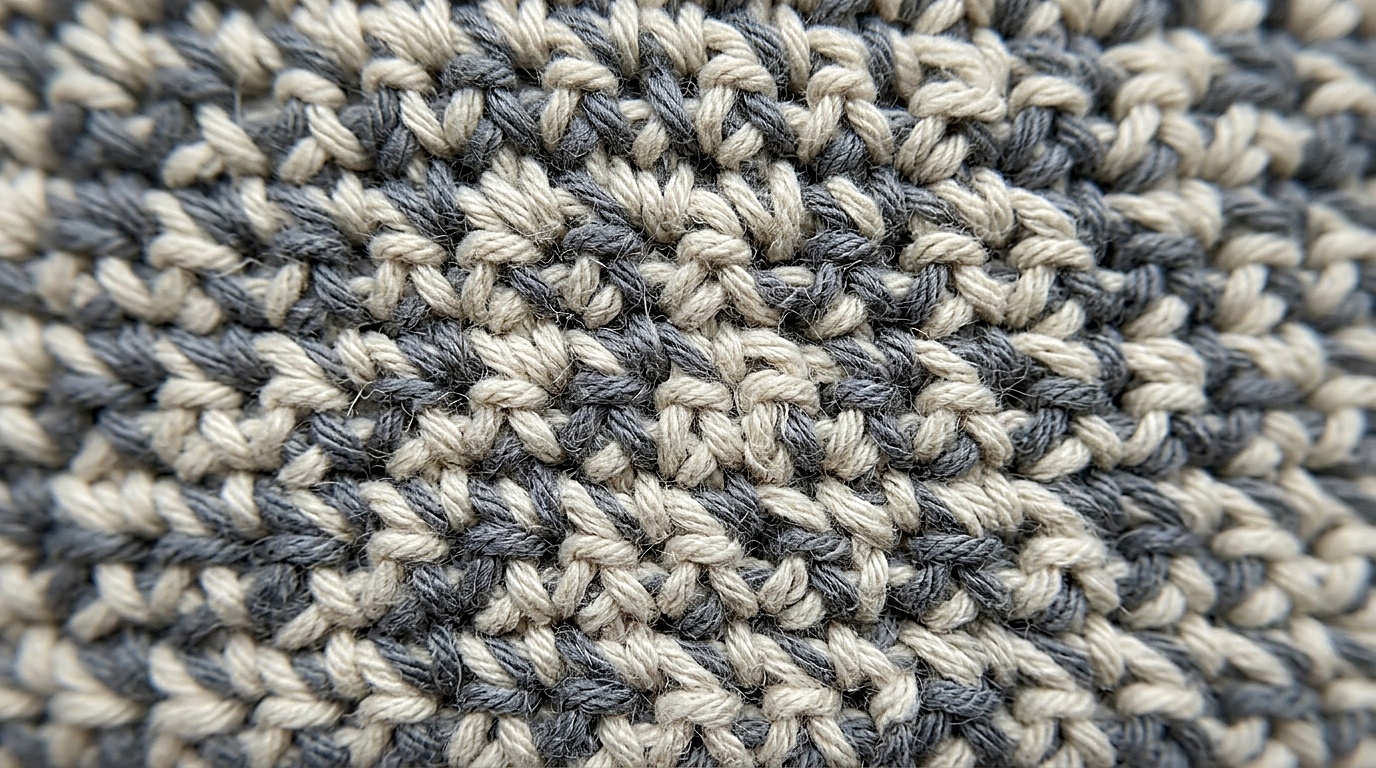
Unlike complex post stitches that require count-heavy attention, moss stitch operates on a rhythmic one-row repeat once established. Its greatest challenge for beginners is keeping side borders straight. Beginners frequently drop the final chain space at the edge of the row, causing the fabric to taper into a triangle. In this guide, we break down edge alignment and stitch multiple math.
Stitch Mechanics: Why Working into Chain Spaces Creates Fluid Drape
The structural secret of the moss stitch lies in where your hook enters the fabric:
- Space Insertion: You never insert your hook into the top loops of the single crochet stitches below. Instead, your hook passes underneath the chain-1 arch nestled between the posts.
- Interlocking Bricks: Each single crochet sits centered above the open space from the row beneath, while each chain space spans over the crown of the previous stitch. This staggered layout mimics woven linen cloth.
- Elimination of Fabric Bias: Because single crochets naturally lean slightly to one side, solid rows can skew diagonally. The intervening chain-1 space neutralizes this lean, keeping blankets and scarves perfectly rectangular.
Multiple Math & Swatch Standards

- STITCH_MULTIPLE: Any even number of chains (Multiple of 2).
- RECOMMENDED_HOOK: 5.0 mm (US Size H/8) or 5.5 mm (US Size I/9). Sizing up by 0.5 mm beyond the yarn label recommendation prevents the chain spaces from tightening.
- RECOMMENDED_YARN: Category #3 DK or Category #4 Worsted weight yarn with smooth ply definition.
- TARGET_GAUGE: [Target Pattern Standard — GAUGE: NEEDS PHYSICAL VERIFICATION for maker tension]
18 sts (9 sc + 9 ch-1 spaces) × 16 rows = 10 × 10 cm (4 × 4 inches).
Step-by-Step Swatch: Setting Up the Working Repeat
Work a practice swatch on a foundation of 20 chains:
Foundation Row: Chain 20 loosely with your 5.0 mm hook.
Row 1 (Setup Row): Single crochet into the 4th chain from the hook (the 3 skipped chains count as 1 sc + 1 ch-1 space). *Chain 1, skip 1 foundation chain, single crochet into the next chain*. Repeat from * to * across the chain until 1 chain remains. End with a single crochet in the final chain. Turn. (9 sc and 9 ch-1 spaces formed)

Row 2 (The Universal Repeat): Ch 2 (counts as 1 sc + 1 ch-1 space). Skip the first sc. *Single crochet into the first ch-1 space, chain 1, skip the next sc*. Repeat from * to * across the row. The final single crochet is worked directly into the turning ch-2 space from the previous row. Turn.
Rows 3 and Beyond: Repeat Row 2 continuously. As you work, each row mirrors the previous row exactly, producing clean, parallel edges.
The Secret to Laser-Straight Edges
If your moss stitch edges are slanting inward or billowing outward, review these two focal points:
- Capturing the Final Turning Space: When reaching the end of Row 2, the last single crochet must be worked into the space formed by the beginning ch-2 of the row below. Missing this space causes you to lose 1 stitch per row.
- The Ch-2 Turning Rule: Always turn with Chain 2, not Chain 1. Chain 1 is too tight to serve as both an edge rise and a functioning chain space on the return pass.
Color Striping & Project Inspiration

Moss stitch is especially renowned for multi-color striping. When you change yarn colors every 1 or 2 rows, the single crochets of the new color dip into the spaces of the old color, creating a softened, speckled tweed transition without harsh jagged lines.
Save This Tutorial to Pinterest
Mastering fundamental crochet textures? Save these official tutorial cards to your Pinterest boards to keep the stitch repeat handy.