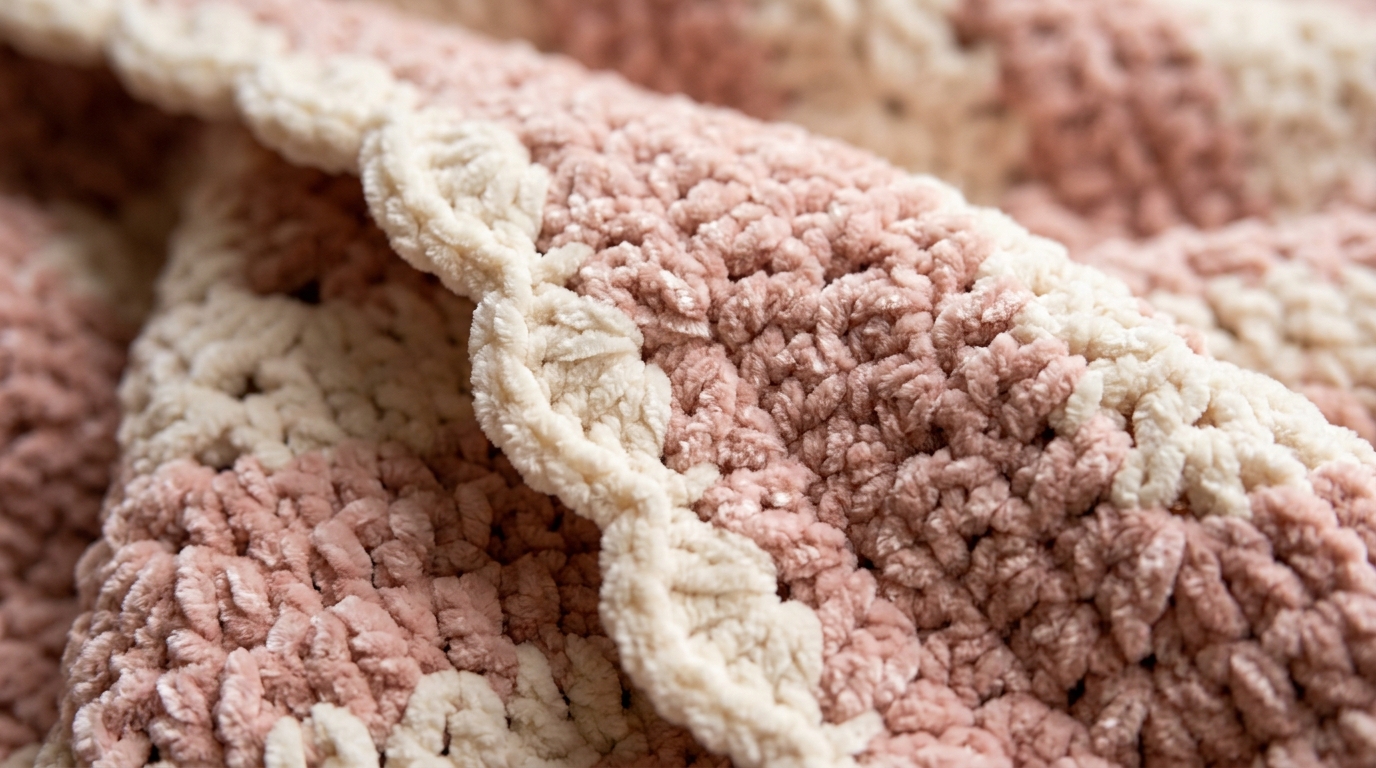
There is something undeniably magical about holding a handmade velvet baby blanket. The ultra-fine micro-plush fibers of chenille yarn create a weightless, cloud-like warmth that feels soothing against delicate infant skin. Whether you are crafting an heirloom shower gift for an expectant mother or building a calming sanctuary in your little one’s nursery, this free crochet pattern pairs an effortless, non-snagging stitch texture with a delicate scalloped shell border that looks polished and timeless.
Jump directly to yarn requirements, sizing charts, and row-by-row instructions.
Quick Project Specifications
- Skill Level: Easy / Confident Beginner (uses half double crochet and standard double crochet shells).
- Crochet Terminology: US Standard Terms.
- Yarn: Category #5 Bulky Chenille / Velvet Yarn (such as Bernat Baby Velvet or Lion Brand Vel-Luxe). Approximately 900–950 yards (approx. 3 skeins of 300g / 492 yds each; 2 skeins in Main Color Dusty Rose, 1 skein in Contrast Color Cream). (Calculated design estimate; actual consumption may vary based on tension).
- Crochet Hook: 6.0 mm (US J-10) ergonomic aluminum hook, or size needed to obtain gauge. (Check our Crochet Hook Sizes Guide & Conversion Chart if substituting hook sizes).
- Notions: Large-eye bent metal tapestry needle, sharp embroidery snips, flexible measuring tape, and 4 locking stitch markers.
- Estimated Finished Dimensions: Approximately 32 × 36 inches (81 × 91 cm) rectangular stroller blanket, including perimeter shell border.
- Design Gauge: 11 stitches × 9 rows = 4 × 4 inches (10 × 10 cm) in Wide Half Double Crochet, measured flat without tension.
- Stitch Multiple: Multiple of 2 stitches + 1 (for foundation chain: multiple of 2 + 2).
Pattern Abbreviations
- ch: chain
- st(s): stitch(es)
- sp: space
- sc: single crochet
- hdc: half double crochet
- Wide-hdc: wide half double crochet (worked into the space between the posts of stitches rather than into top loops)
- dc: double crochet
- sl st: slip stitch
- MC: Main Color (Dusty Rose Blush)
- CC: Contrast Color (Cashmere Cream)
- [ ]: stitch counts at the end of the row
- * to *: repeat instructions between asterisks as indicated
Why Velvet Yarn Behaves Differently: Preventing “Worming”
Velvet and chenille yarns consist of a thin central core thread wrapped in thousands of tiny cut pile tufts. Because the surface is so silky and slick, velvet yarn has virtually no natural friction between neighboring strands. If you crochet with loose tension or oversized stitches, these slippery fibers can wiggle out of the stitch matrix after gentle tugging or laundering—a frustrating phenomenon known among crocheters as “worming” (where loose loops loop out like tiny worms across the surface of your fabric).

To eliminate worming completely and create a blanket that stays buttery smooth through years of use, we employ two studio-proven techniques:
- Downsizing the Hook: While velvet yarn labels often recommend a 6.5 mm or 7.0 mm hook, working with a 6.0 mm (US J-10) hook produces a slightly firmer, snugger stitch that physically captures the core thread without making the fabric stiff.
- Working Wide Half Double Crochets (Between Posts): Instead of inserting your hook under the standard top V-loops, you slide the hook into the open space directly between the vertical posts of the stitches below. This encases the previous row firmly, preventing any single loop from traveling or escaping.
Technique Breakdown: The Wide Half Double Crochet (Wide-HDC)
The Wide Half Double Crochet (also known as the “HDC between posts” or “space HDC”) is the secret to a perfectly uniform, reversible velvet fabric with zero snagging:

- Yarn over your hook from back to front.
- Locate insertion point: Instead of inserting under the top two loops of the stitch, insert your hook into the open space between the vertical post of the stitch just worked and the next stitch’s post.
- Yarn over and pull up a loop: You now have 3 loops on your hook. Keep your tension moderate and even.
- Yarn over and draw through all 3 loops on the hook to complete the stitch.
Step-by-Step Velvet Baby Blanket Pattern
Foundation Chain: With Main Color (Dusty Rose) and 6.0 mm hook, chain 84 loosely.
Row 1 (Foundation Row): Work 1 hdc in the 3rd chain from the hook. Work 1 hdc in each remaining chain across to the end. Turn. [82 hdc stitches; beginning skipped chains do not count as a stitch].
Row 2 (Main Body Texture): Ch 2 (does not count as st throughout). Work 1 Wide-HDC in the space between the turning chain and the first hdc post. Work 1 Wide-HDC in each space between posts across the row, working the final Wide-HDC in the space between the last stitch and the turning chain below. Turn. [82 Wide-HDC stitches].
Rows 3–72: Repeat Row 2 until your blanket reaches approximately 33 inches (84 cm) in length, or your desired rectangular dimensions. For the subtle color-blocked band shown in our sample, work Rows 1–48 in Main Color (Dusty Rose), switch to Contrast Color (Cream) for Rows 49–60, and return to Main Color for Rows 61–72. Fasten off MC.
Crocheting the Scalloped Shell Border
The scalloped shell border frames the plush velvet body with romantic, heirloom charm. It is worked in two continuous rounds using Contrast Color (Cashmere Cream):

- Round 1 (Base Single Crochet Setup): Join Contrast Color (Cream) with a slip stitch into any corner stitch. Ch 1.
- Work
(1 sc, ch 1, 1 sc)into the corner anchor stitch. - Along the top edge: Work 1 sc into each of the 80 intermediate stitches across.
- In next corner: Work
(1 sc, ch 1, 1 sc). - Along row-end edge: Work single crochets evenly down the side, placing approximately 1 sc into each row-end space (approx. 72 intermediate sc).
- In next corner: Work
(1 sc, ch 1, 1 sc). - Along bottom edge: Work 1 sc into each of the 80 intermediate foundation chain loops across.
- In final corner: Work
(1 sc, ch 1, 1 sc). - Along remaining row-end edge: Work approx. 72 intermediate sc evenly up the side. Join with a sl st to the first sc. Do not turn.
- Work
- Round 2 (Scalloped Shell Round): Sl st into the corner ch-1 space.
- Corner Shell: Work
(1 sc, ch 1, 7 dc)into the corner space to form an expanded corner fan. - Edge Shell Repeat: *Skip 1 stitch, work 1 sc in the next stitch, skip 1 stitch, work 5 dc into the next stitch*. Repeat from * to * across the side until you reach the next corner space.
- Repeat this sequence around all four edges and corners of the blanket.
- Join: Sl st into the first sc of the beginning corner. Fasten off CC, leaving a 20 cm tail for weaving.
- Corner Shell: Work
Finishing, Weaving Tails & Nursery Styling

- How to Weave Chenille Tails Securely: Because velvet core threads are slick, never simply weave a tail in a straight line. Thread your tail onto a bent tapestry needle, weave it through the center of several stitches, split the ply of an adjacent stitch, reverse directions, and weave back across. Working in three opposing directions locks the microfibers permanently in place.
- Laundering Velvet Blankets: Machine wash cold on the gentle cycle inside a mesh laundry bag. Never wash velvet with items containing zippers, hooks, or Velcro.
- Drying: Lay flat on a clean dry towel to air dry, or tumble dry on the lowest delicate heat setting without dryer sheets. Heat above warm can melt synthetic chenille fibers.
- Pairing with Nursery Gifts: Looking to create a matching heirloom gift set? Pair this throw with our beloved Soft & Cosy Crochet Baby Booties Pattern worked in matching organic pastels, or explore our Chunky Waffle Crochet Blanket Tutorial for oversized family throws.
Maker Troubleshooting & FAQ
Why is my velvet blanket stiff instead of drapeable?
If your fabric feels more like a dense rug than a soft blanket, your tension is too tight. Velvet yarn requires room for the plush fibers to breathe. Size up your crochet hook by 0.5 mm to a 6.5 mm (US K-10.5) hook and relax your working hand.
Can I make this blanket in a larger crib or throw size?
Yes! The foundation multiple is 2 + 2. To adjust width, add or subtract chains in multiples of 2. For a standard crib blanket (36 × 45 inches), chain 96 and work approximately 88 rows. For a generous sofa throw (50 × 60 inches), chain 134 and work approximately 120 rows.
How do I fix a loose velvet loop that pulled out?
Do not cut it! Insert your crochet hook from the wrong side of the fabric directly beneath the pulled loop, grab the loose yarn strand, and gently pull it through to the back of the blanket. Tug gently on adjacent stitches along the row to redistribute the tension across the neighboring posts.
Save This Velvet Blanket Pattern to Pinterest
Planning your next nursery project or handmade baby shower gift? Save these step-by-step pin guides to your crochet baby blankets or nursery crafts board on Pinterest.